Posted by Nick Sieger
Fri, 12 Jun 2009 20:34:27 GMT
I started in on the twice-yearly task of pruning our hedges today. So confronted with this task:
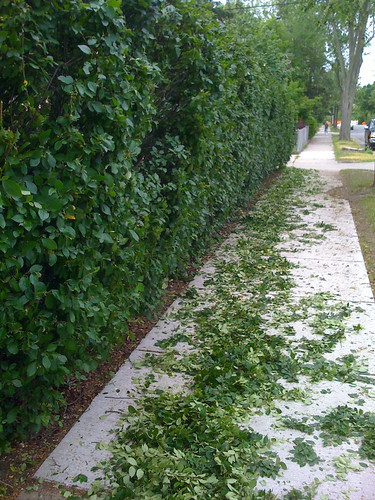
Which tool would you use?
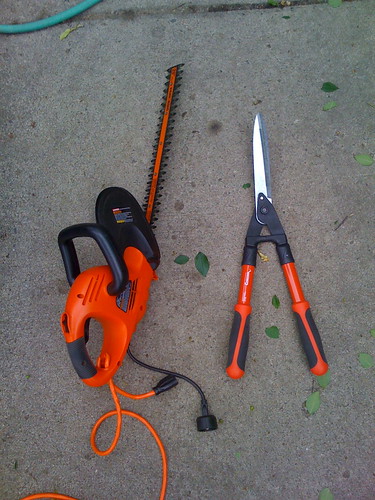
I used both today, but realized I enjoy using the hand trimmers much more. With the electric trimmers, you can buzz through a lot of hedge quickly, but sometimes this happens:
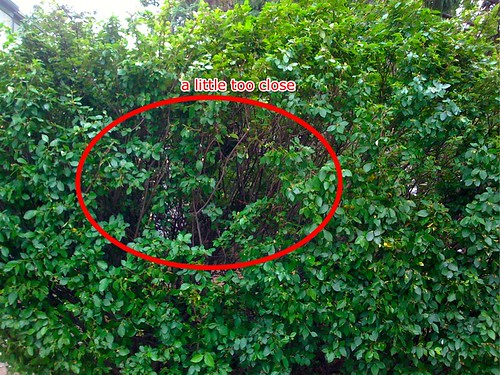
With the hand trimmers, I can take my time and make precise cuts. The end result may take more time, but it turns out much, much better.
Software tools have similar feels to me. Java feels an awful lot like the electric trimmers. It’s heavy and powerful, but sometimes by the time you’ve finished with it, you’ve cut so far in that you may have missed a simpler, lighter solution.
Ruby feels like the hand trimmers. Precision, less code, more intent, and I can take my time to think through and arrive at a solution without leaving a huge trail of trimmings (code) behind me.
Tags ruby | 4 comments
Posted by Nick Sieger
Tue, 09 Jun 2009 02:23:36 GMT
It’s just the beginning and a small milestone, but it’s a goal we set for ourselves by JavaOne last week that we reached: 10K registered users at http://kenai.com/. We were fortunate to be highlighted in the Tuesday afternoon keynote, which, to our collective relief, went off without a hitch. I also had a chance to speak a bit about Project Kenai behind the scenes in my technical session.
My slides are available and contain a decent overview of what we’ve been doing. One slide in particular seems to have surprised some folks: our codebase metrics.
- 12K lines of application code (everything in
app/{controllers,models,helpers})
- 10K lines of views (HTML + template code in
app/views)
- 1K lines of custom Javascript (
public/javascripts excluding jQuery and plugins)
- 8K lines of test code (RSpec + plain text stories) (yes, we’re upgrading to Cucumber)
- 73.7% test coverage
If you’re doing Rails, you’re probably not all that surprised by these numbers; hopefully you’ve seen similar ones yourself. If you haven’t tried Rails, consider a site like kenai.com and ask yourself if you could build and maintain a production site like it with these numbers in your favorite language/framework.
Other takeaways from my talk:
- Use Java what it’s good for; in this case, long-running server apps. The downtime of the JRuby/GlassFish-deployed Rails application has been minimal for us; the few cases where we’ve had issues, they’ve usually been self-inflicted application problems. Instead of running Monit with a pack of Mongrels that need to be periodically recycled, we run a few GlassFish domains per server and only recycle them when we deploy new code.
- For the Java programmers out there, don’t be afraid to use stuff other than Java. We use Python, Django, Memcached, Perl, and anything that gets the job done.
- You can build cool stuff quickly with community Rails plugins like attachment_fu, geokit, and will_paginate. Not news to Rails programmers, but I’d be interested to hear of any equivalents for Java-based web frameworks.
- JRuby is a big win, allowing co-development on MRI and JRuby with deployment to GlassFish. JRuby’s java integration also allows for neat tricks like image_voodoo, a pure-Java imaging plugin for attachment_fu.
Tags jruby, kenai, rails | 3 comments
